Summer – the perfect time for family vacations, long weekends, and overall, a more relaxed mindset. Your company may deal with lighter staffing. And while your team is checking out, attackers are checking in. Having less staff and lowered defenses makes summer prime time for social engineering attacks. Reduced workforce and slower response times as well as autoreplies and public travel posts give attackers context to craft effective pretexts. Let’s look at a real-life scenario.
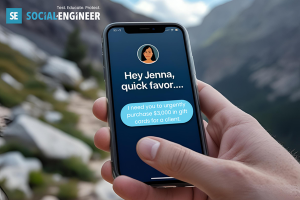
It was a quiet Friday afternoon. Jenna knew her manager, Daniel, had left the previous day for his family vacation. She suddenly receives a text from him: “Hey Jenna, quick favor — I need you to urgently purchase $3,000 in gift cards for a client. Can’t call, reception is bad. Just text me the codes once you get them. Thanks!”
Caught off guard but eager to help, Jenna hesitated only briefly. Daniel was usually prepared, but he was also known for last-minute client gestures. Still, something didn’t sit right. She texted back, “Are you sure you want me to use the company card for this?” The response was swift: “Yes, no time to explain. I’ll reimburse later if needed.” Jenna complied.
An hour later, the real Daniel emailed from a lodge with spotty Wi-Fi. “Hey team, loving the trails — no phone service but checking emails when I can. Let me know if anything urgent comes up!” Her stomach dropped. The “boss” had been a scammer. They had used Daniel’s public vacation notice as an opening, spoofed his number, and played on urgency.
Some attack vectors become especially effective during the summer vacation season. Here’s what to watch for—and how to reduce your risk.
Seasonal Phishing Surges
Phishing is a commonly used vector for social engineering attacks during the summer months. Attackers take advantage of seasonal behaviors and distractions. With many employees taking vacations or working irregular hours, there is often a lapse in attentiveness to digital communications. Cybercriminals exploit this by sending emails that appear to be related to travel confirmations, out-of-office notices, or company policy updates. These messages are carefully crafted and can seem very realistic and will contain malicious links or attachments designed to steal login credentials or install malware. The increased reliance on email for coordination during time off in the summer months also contributes to employees responding more quickly without verifying authenticity, making phishing an especially effective tactic during this time.
Vishing and Smishing on the Rise
Vishing (voice phishing) and smishing (SMS phishing) are also commonly used social engineering vectors during the summer months when individuals are more likely to be traveling or working outside of their usual routines. Cybercriminals exploit this seasonal shift by making deceptive phone calls that appear urgent or sending fraudulent text messages, such as fake travel alerts or a message from their manager needing them to contact them. With people often relying more heavily on their mobile devices while away from their desks, they may be more inclined to answer unknown calls or respond to suspicious texts without verifying the source.
Impersonation Tactics Thrive in the Summer
Impersonation can happen in person—through attackers pretending to be new interns, contractors, or temporary facility staff —or virtually, by sending emails that appear to come from trusted vendors or colleagues. In either case, impersonation attacks become more common during the summer months as cybercriminals exploit reduced staffing during vacation time. With key personnel out of the office, there’s a higher chance that an urgent-sounding email or message—such as a request for a wire transfer, sensitive data, or login credentials.
Staying Cool Under Pressure – Tips to Defend Your Team
Here are some effective strategies to help your team stay calm and make informed decisions when facing high-pressure scams. These tips apply year-round, including during the busy summer season.
1. Refresh Security Training with Interactive Tools
Incorporate interactive elements like quizzes, simulations, and role-playing scenarios that reflect real-world threats; this will help employees apply the security tips they learn in practical contexts. Regularly updating training content to address emerging threats keeps employees engaged and reinforces awareness. Short periodic sessions can also help maintain retention without overwhelming staff. Additionally, gamifying the training experience and recognizing employee achievements can boost participation and motivation.
2. Revisit Out-of-Office Message Best Practices
Employees should avoid revealing too much information in their auto-responses as it could be exploited by malicious actors. While it’s helpful to let senders know you’re out of the office or unavailable, including specific details like your exact location, duration of absence, or alternative contacts, can aid cyber criminals in creating an effective pretext that could be used in vishing or phishing. Instead, keep messages brief and general—for example, stating that you’re currently unavailable and will respond as soon as possible. If necessary, direct urgent matters to a general company email or a monitored team inbox rather than an individual’s contact details. By limiting the information shared in auto-responses, you reduce the risk of exposing sensitive details that could compromise your organization’s security.
3. Conduct Vishing Simulations
Vishing involves attackers using phone calls to manipulate employees into revealing sensitive information, such as login credentials or company data. By simulating these types of attacks in a controlled environment, organizations can assess how well employees recognize and respond to social engineering tactics. Including some possible scenarios that could occur during the summer months can provide an opportunity to educate staff on common red flags, such as urgent requests, unfamiliar caller IDs, or pressure to bypass standard procedures. Ultimately, regular vishing drills build a culture of vigilance and help reduce the risk of successful voice-based attacks.
4. Encourage a ‘Verify First’ Culture
Cybercriminals often impersonate high-ranking officials or trusted partners to pressure employees into bypassing standard protocols—such as urgently requesting wire transfers, sensitive data, or system access. By promoting a mindset where employees are empowered and expected to pause and verify before acting on any unexpected or suspicious requests, companies can greatly reduce the risk of falling victim to scams. Verification can be as simple as a quick phone call or confirming through an internal messaging system. Reinforcing this practice through training and positive reinforcement creates a workplace culture where caution is valued over blind compliance.
Be Proactive
What can be learned from the scenario at the beginning of the article? The company lost $3,000 that day, but Jenna learned a priceless lesson: urgency should never override verification. Just because the temperature is rising doesn’t mean your guard should drop.
Use the slower summer months to reinforce your defenses and educate your team. Also, providing ongoing security awareness education throughout the year can empower employees to recognize and respond to threats effectively. Relevant and interactive training fosters a security-aware culture that significantly reduces risk and strengthens the organization’s overall resilience. Remember, when the office is quiet the attackers get loud. Summer doesn’t have to be your weakest link – as you train throughout the year, focus on the specific threats of the season, not just the general threat.
Ready to take your security to the next level? Explore our offensive security services at social-engineer.com to identify vulnerabilities before attackers do and build a stronger, smarter defense. Don’t wait for a costly mistake—empower your team with real-world simulations and expert guidance today. Your organization’s resilience depends on it.
Written by
Rosa Rowles
Human Risk Analyst, Social-Engineer, LLC