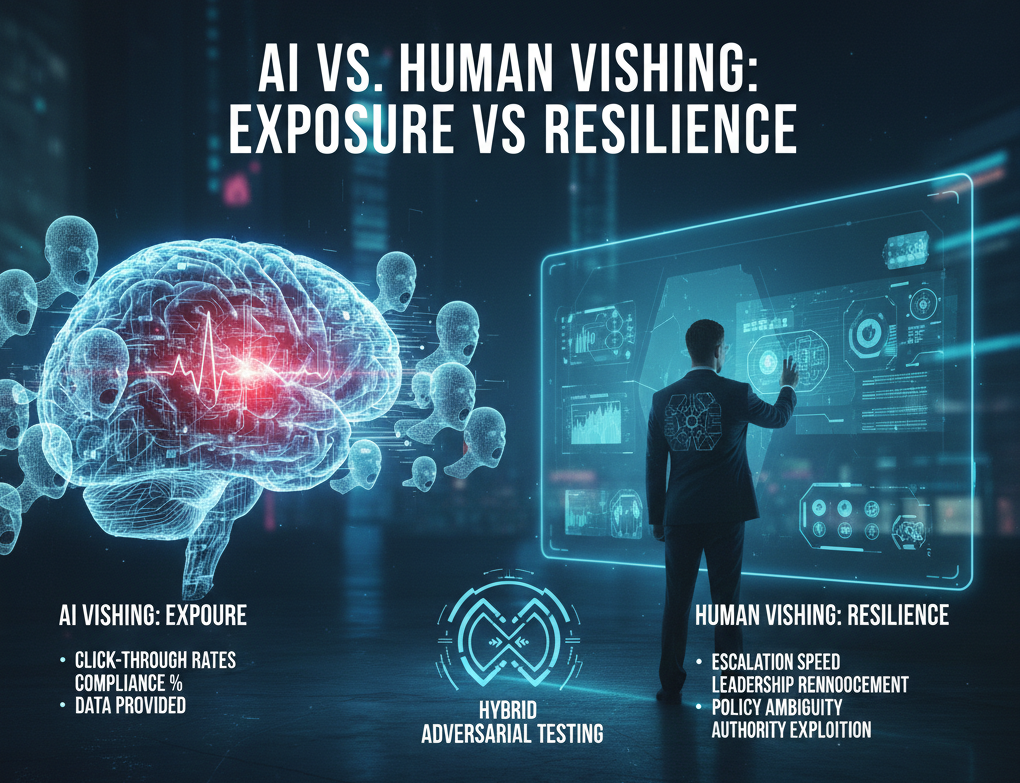
In my LinkedIn Post I covered the basics of the difference between AI vishing and Human to Human Vishing, but let’s dive deeper here.

AI vishing measures exposure. Human-led adversarial engagements measure resilience.

Exposure tells you how many employees clicked, complied, or provided information.

Resilience tells you:

• How quickly employees escalate concerns
• Whether leadership reinforces verification behavior
• Where policy ambiguity creates friction
• How culture influences decision-making under pressure
• Which departments are most susceptible to authority exploitation

These insights do not always appear in large-scale automation reports. They surface in dynamic conversations or when someone pushes back. They surface when resistance forces adaptation, and that is where mature security programs gain real advantage.


The Hybrid Future

The conversation should not be framed as AI versus humans. The future of adversarial testing is layered. AI to test broad exposure and benchmark awareness but then human operators to simulate determined, thinking adversaries. Hybrid campaigns to create realistic threat models that reflect modern attacker behavior.

Organizations that rely solely on automation will gather data. Organizations that combine scale with adaptive realism will gain insight. And insight is what drives strategic security decisions.


Questions CISOs Should Be Asking Vendors

If you are evaluating vishing providers in 2026, ask:

  1. How do you measure insight beyond compliance rates?
  2. How do you simulate adaptive adversaries?
  3. What happens when a target pushes back or escalates?
  4. Can you differentiate exposure metrics from resilience analysis?
  5. How do you prevent psychological fatigue or trust erosion from over-testing?

If those questions make a vendor uncomfortable, that tells you something.


Final Thought

AI vishing is a powerful advancement. But tools do not create mastery. Operators do.

At SECOM, we use AI where it makes sense. We deploy human operators where realism matters. And we design hybrid adversarial campaigns for organizations that want more than metrics. They want understanding.

If you are building a serious human risk program and want to explore what layered adversarial testing would look like in your environment, let’s have that conversation.


Security Assessment Case Study
Learn more about the importance of a Social Engineering Risk Assessment.
Security Assessment Case Study
Learn more about the importance of a Social Engineering Risk Assessment.
What Makes Us Different
At Social-Engineer, we pride ourselves on what we do and how we do it. We are a security services provider, focusing on four primary attack vectors. This case study will go through how we can protect your company and what makes us different.
What Makes Us Different
At Social-Engineer, we pride ourselves on what we do and how we do it. We are a security services provider, focusing on four primary attack vectors. This case study will go through how we can protect your company and what makes us different.
Woman vs Machine
Technology is providing new, more innovative ways to enhance our world. Scientists are constantly developing smarter, faster and more intelligent machines, systems and robots. There is no doubt that each of these has evolved beyond their clockwork origins.
Woman vs Machine
Technology is providing new, more innovative ways to enhance our world. Scientists are constantly developing smarter, faster and more intelligent machines, systems and robots. There is no doubt that each of these has evolved beyond their clockwork origins.
Vishing and Phishing Must Be Ongoing to Be Effective
Most companies have a security awareness program in one form or another. If they don’t, it should be on the short list of programs to start as soon as possible. In our experience, many of these programs take the form of computer-based training.
Vishing and Phishing Must Be Ongoing to Be Effective
Most companies have a security awareness program in one form or another. If they don’t, it should be on the short list of programs to start as soon as possible. In our experience, many of these programs take the form of computer-based training.
A Case Study in Vishing
Vishing (voice-based phishing) has been a problem for quite a long time. There are many vendors in the marketplace that offer vishing services. However they tend to use robo-callers or call centers for large volume engagements. If they are using trained humans to make calls, it is likely in very low numbers.
A Case Study in Vishing
Vishing (voice-based phishing) has been a problem for quite a long time. There are many vendors in the marketplace that offer vishing services. However they tend to use robo-callers or call centers for large volume engagements. If they are using trained humans to make calls, it is likely in very low numbers.
Benefits of a Social-Engineering Risk Assessment Engagement
Your company is important. Indeed, the data you hold for your clients or employees is very valuable and attackers seek to capitalize on that data any way they can. This is where a Social Engineering Risk Assessment (SERA) engagement can help uncover possible vulnerability to attackers.
Benefits of a Social-Engineering Risk Assessment Engagement
Your company is important. Indeed, the data you hold for your clients or employees is very valuable and attackers seek to capitalize on that data any way they can. This is where a Social Engineering Risk Assessment (SERA) engagement can help uncover possible vulnerability to attackers.
The Business Value of the Social-Engineer Phishing Service
Cybercriminals are targeting the human element of organizations. Additionally, they are developing techniques to use an organization’s employees as the first point of entry. According to the 2021 Verizon DBIR report, of the 3,841 security breaches reported using social engineering, phishing was the key vector for over 80% of them.
The Business Value of the Social-Engineer Phishing Service
Cybercriminals are targeting the human element of organizations. Additionally, they are developing techniques to use an organization’s employees as the first point of entry. According to the 2021 Verizon DBIR report, of the 3,841 security breaches reported using social engineering, phishing was the key vector for over 80% of them.