In cybersecurity, it’s often said that the strongest systems can still be undone by a single human decision. No matter how advanced your technology stack is, a well-crafted phone call or email exploiting someone’s instinct to comply can bring it all down. Attackers don’t just target software; they target psychology. And one of their most reliable tools is the human response to authority.
From fake “urgent” messages supposedly sent by executives to phone calls from individuals claiming to be IT or law enforcement, these tactics work because they rely on something deeply ingrained in most of us: the impulse to obey authority figures and avoid conflict. In high-pressure moments, many employees may not stop to think, but rather just act.
Why Authority Works So Well
Authority works because it feels safe to follow it. Since childhood, people are conditioned to trust those who appear to have expertise, status, or control, such as teachers, managers, police officers, company leaders. And in the workplace, that conditioning continues. We learn that good employees follow instructions, move quickly when higher-ups make requests, and avoid questioning leadership decisions.
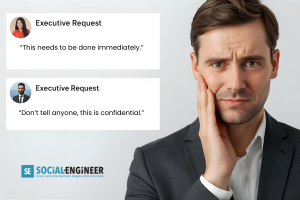
Cybercriminals take advantage of that structure and mindset. When they impersonate a senior executive or official tone, they tap into an emotional shortcut that we have: “They’re in charge, so I must comply.” Often, these messages are framed with urgency or pressure:
- “This needs to be done immediately.”
- “Don’t tell anyone, this is confidential.”
- “You’ll be responsible if this delay causes problems.”
These statements don’t just convey a sense of authority; they also create fear. Fear of disappointing a superior, of being blamed for slowing things down, or of appearing incompetent. Under stress, critical thinking collapses, and instinct takes over. That’s when the attacker wins.
The Solution: Psychological Safety
Technology can’t patch the human mind, but culture can re-shape it. The most resilient organizations are those that create psychological safety and address the human element. They create an environment where people can speak up, ask questions, or say “no” without fearing ridicule.
Psychological safety turns hesitation into a strength. It helps not to suppress the gut feeling one gets when something doesn’t seem right. When employees know that verifying a suspicious request won’t earn them scolding or mockery, they can become active participants in defense rather than passive targets. That pause, the moment someone stops and thinks, is where attacks are thwarted in cybersecurity. It’s a pause that can save a company’s data and reputation.
Leaders must communicate that safety explicitly. They should tell their teams that it’s okay to double or triple-check, even when the request seems to come from high up. When employees see leaders welcome verification instead of taking offense, trust starts to grow and fear fades.
How to Build a “No-Is-Okay” Culture
1. Leaders Set the Tone
Culture starts at the top. Executives and managers need to make it clear that caution is valued, even under pressure. A leader saying, “If you ever get a message from me asking for something unusual, always confirm it through another channel,” creates a ripple effect of confidence and empowerment across the team. They take the lead in being security conscious.
2. Reward Vigilance, Not Just Compliance
Too often, companies celebrate speed and efficiency but overlook careful thinking. Recognize and show public appreciation for employees who prevent potential security incidents by asking questions or delaying an action that didn’t feel right. When people see that skepticism earns praise instead of punishment, others follow their lead. Most importantly, it should be conveyed that such actions protect not just the individual, but rather the entire company as a whole, including each employee.
3. Simplify the Verification Process
Employees are more likely to double-check suspicious requests if it is easy to do so. Provide them with quick verification tools such as dedicated Slack channels, one-tap phishing report buttons, or a direct contact line for the security team. A streamlined reporting process that removes tedious barriers encourages action on an employee’s part. They can have all the resources they need to alert their proper channels.
4. Train for Pressure, Not Just Awareness
Many awareness programs show slides of phishing emails but don’t simulate the emotional tension that makes people slip. Include realistic role-play scenarios, urgent phone calls, messages from “executives,” or mock crises to help employees recognize manipulation in the moment. Often, the interactive aspect creates lasting memory and helps staff to remember how a suspicious request could feel. Familiarity with that feeling of pressure is what builds instinctive resistance.
5. Reframe “Questioning” as “Protecting”
The word “questioning” often carried a negative connotation. However, employees should understand that questioning authority isn’t an act of disobedience, it’s a form of protection. By verifying instructions, they’re protecting the person being impersonated, the company’s reputation, and themselves. This reframing changes the emotional narrative from “I’m being difficult” to “I’m being responsible”. This simple reframing can be all an employee needs to stop, take a moment, and trust their gut.
From Obedience to Empowerment
Creating a culture where “no” isn’t a threat doesn’t mean encouraging defiance, it means fostering confidence. Employees who feel safe to question are not rebellious; they’re aware. They’re engaged. They understand that real trust in the workplace includes the freedom to verify.
The more an organization encourages that mindset, the harder it becomes for attackers to weaponize authority. In the end, cybersecurity isn’t just about technology, it’s about people who know their voice matters, even when it’s saying the simplest and most powerful word in security: no.
Where Social-Engineer LLC Fits In
Building this kind of culture doesn’t happen by accident. It takes practice, reinforcement, and exposure to the kinds of real-world pressure attackers exploit every day. That’s where Social-Engineer LLC’s human-focused security programs support organizations.
Our training is built around the psychology described above: authority, urgency, conflict avoidance, trust, and emotional manipulation. Through live vishing engagements, leadership-focused assessments, teams learn to recognize the emotional pressure behind an attack, not just the technical indicators.
Organizations often tell us that the most valuable outcome isn’t just fewer clicks or prevented breaches; it’s the mindset shift. Employees feel confident slowing down, validating instructions, and speaking up when something feels off. Leaders gain clearer insight into how authority is leveraged in their own environment, and they learn how to communicate security expectations in a way that empowers rather than intimidates.
For companies looking to build a culture where employees know their voice matters, these programs create the reinforcement, realism, and psychological safety, needed to make “no” a protective reflex instead of a stressful choice. For more information, contact us today.
Written by
Josten Peña
Human Risk Analyst, Social-Engineer, LLC